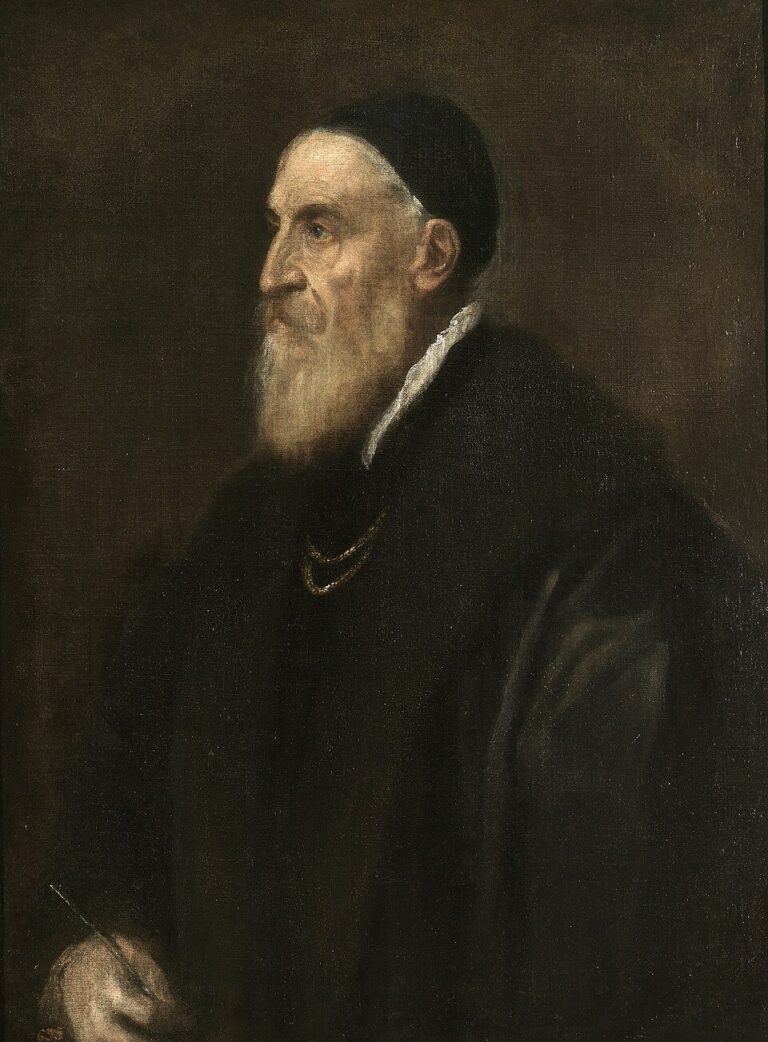
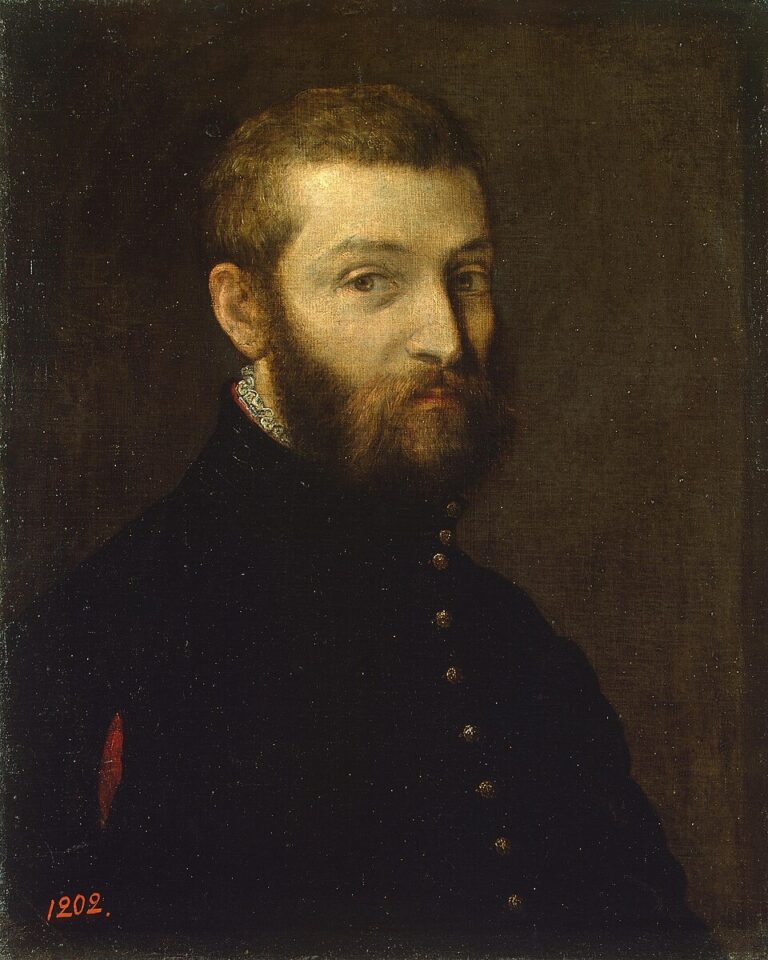
Tintoretto — the Fury of Venice
In sixteenth-century Venice, while Titian reigned as the undisputed master of painting, a young artist with a fiery temperament overturned every convention: Jacopo Robusti, whom history would remember as Tintoretto. Through the sheer energy of his brush, the daring of his compositions and the dramatic power of his lighting, he gave Venetian painting a new, theatrical and visionary breath — one that already pointed towards the Baroque.
Born around 1518 and dying in 1594 in his native city, which he scarcely ever left, Tintoretto is, together with Titian and Veronese, one of the three giants of the Venetian school. Nicknamed Il Furioso, “the Furious”, for the phenomenal energy and startling speed with which he painted, he left behind an immense body of work dominated by vast religious cycles of overwhelming intensity. His masterpiece, the enormous decorative ensemble of the Scuola Grande di San Rocco, is often compared, for its scale and force, to the Sistine Chapel.
What defines Tintoretto is an ambition he set out in his youth in a now-famous motto: to unite “the drawing of Michelangelo and the colour of Titian”. He dreamed of fusing the sculptural power and sense of movement of the Florentine master with the chromatic magic of the Venetian school. From this synthesis he drew a deeply personal art of muscular, dynamic figures, daring foreshortenings, dizzying perspectives and supernatural lighting, all in the service of stagecraft of unmatched dramatic intensity.
This article traces the life and work of this master of the Venetian Renaissance — the dyer’s son, Titian’s rival, the tireless decorator of Venice, the prophet of the Baroque. As Tintoretto is in the public domain, his works may be freely admired and reproduced — we describe the most significant ones here.
Venice, the dyer’s son
Tintoretto was born in Venice around 1518, into a family of modest means. His nickname, under which he passed into posterity, tells in itself of his origins and his roots in the world of the Serenissima’s craftsmen.
His real name was Jacopo Robusti, but he is known by the name Tintoretto, which means “the little dyer”. The nickname came from the trade of his father, Battista, who was a dyer — tintore in Italian. The boy thus grew up surrounded by colours, pigments and dyed fabrics, in the world of a craft wholly devoted to coloured matter. Not without reason, this origin has been seen as one of the sources of his early passion for colour and light, which would mark his whole output. The dyer’s son would become a master of colour.
On his training, the sources are uncertain and mixed with legend. Tradition holds that he was, very briefly, a pupil of Titian, the greatest painter in Venice. But the stay in the master’s workshop is said to have been cut short: according to the most common account, Titian, sensing the young man’s exceptional talent and independence, dismissed him for fear of seeing a rival grow. True or embellished, the anecdote captures well the complex relationship, made of admiration and rivalry, that would bind Tintoretto to Titian throughout his life. Other Venetian painters are also named as his possible teachers.
Whatever the truth about his masters, Tintoretto was largely self-taught, working with fierce energy and determination. He opened his own workshop in Venice very young, around the age of twenty. Regarded at first as a mere craftsman, he had to accept varied and sometimes menial work — decorating furniture, chests and panelling for the city’s aristocracy and bourgeoisie. But he studied relentlessly, drawing from antique sculpture and from models, seeking to master anatomy, perspective and light. This period of dogged apprenticeship, in the shadow of the great Titian, prepared the emergence of a genius who would soon impose himself with a bang.
The drawing of Michelangelo and the colour of Titian
Tintoretto’s artistic ambition is contained entirely in a formula he is said to have inscribed on the walls of his workshop: “The drawing of Michelangelo and the colour of Titian”. This motto illuminates his whole output and his singular place in the history of art.
The formula expressed the project of fusing into a single painting the two highest qualities of the art of his time, embodied by two giants. From Michelangelo, the Florentine and Roman master, Tintoretto admired drawing — that is, sovereign mastery of the human body, the sculptural power of figures, the sense of movement and anatomy, monumental grandeur. From Titian, the master of Venice, he admired colour — that Venetian sense of rich, sensuous hue, of light, of vibrant painterly matter. To unite these two traditions, the Florentine art of drawing and the Venetian art of colour, so often opposed, was a bold and novel ambition.
This synthesis placed Tintoretto within the current of Mannerism, that phase of the late Renaissance which, after the classical perfection of the century’s beginning, sought expression, movement, daring, sometimes strangeness. Mannerism had developed in Rome and Florence, notably in Michelangelo’s wake; it reached Venice around the middle of the century, brought by passing artists. Tintoretto, with his generation — that of Veronese and Bassano — sought to renew the Venetian tradition through contact with these new currents. But where Mannerism often aimed at refinement and elegance, Tintoretto infused it with a force, a drama, an intensity all his own.
For Tintoretto did not merely imitate Michelangelo and Titian: he surpassed them by inventing an entirely personal language. From this synthesis he drew a new art, in which the powerful, firmly drawn figures of the Michelangelesque manner came alive with thoroughly Venetian colour and light, in compositions of unprecedented dynamism and daring. He no longer sought the serene, balanced beauty of the classical Renaissance, but emotion, movement, dramatic power. In this he was far more than a Mannerist: a visionary creator who opened the way to Baroque art.
The Miracle of the Slave, the breakthrough
In 1548, a single painting suddenly brought Tintoretto to the attention of all Venice and lifted him out of the anonymity of craftsmen: The Miracle of the Slave, also called The Miracle of Saint Mark. This work marks the true birth of the master.
The painting depicts an episode from the legend of Saint Mark, patron of Venice: a slave, condemned to have his eyes gouged out and his limbs broken for venerating the saint’s relics, is miraculously saved by the intervention of Saint Mark, who plunges from the sky, head down, in a spectacular foreshortening, to shatter the instruments of torture. The scene is handled with astonishing boldness: the saint diving from on high in a dizzying foreshortening, the slave’s nude body stretched on the ground in the foreground, the agitated crowd of figures, the brilliant colours, the dramatic light. Everything is movement, energy, theatre.
Commissioned by the confraternity of Saint Mark, the work caused both a sensation and a scandal. By its daring, its violence, its break with convention, it at first disconcerted part of the public and of the patrons. But it revealed Tintoretto’s genius in broad daylight — his power, his originality, his mastery of dramatic composition and foreshortening. At thirty, the artist established himself as a new and powerful voice in Venetian painting, capable of rivalling the greatest. The dyer’s son had become a master.
The Miracle of the Slave already contains, in embryo, all of Tintoretto’s art. In it we find the synthesis announced by his motto: the powerful, firmly drawn figures inherited from Michelangelo, the rich colour and light of the Venetian tradition. Above all we find what would become his signature: the sense of movement and foreshortening, the daring viewpoints, the spectacular staging, the dramatic power. With this painting, Tintoretto did not merely bring off a successful work: he defined a style, a manner, a vision of painting as sacred and overwhelming theatre. His whole career would develop the promise of this breakthrough.
Il Furioso — Tintoretto’s manner
The nickname his contemporaries gave Tintoretto, Il Furioso, “the Furious”, captures the whole singularity of his manner: an energy, a speed, a daring that amazed and sometimes disconcerted. To understand how he painted is to understand his genius.
Tintoretto painted fast — extraordinarily fast — with a fire that stood out against the meticulous slowness of many masters. This speed, together with the boldness of his brush, his energetic and sometimes sketch-like strokes, earned him both admiration and criticism. Some reproached him for hasty, unfinished work; others admired this virtuosity, this vitality, this capacity to cover vast surfaces with inexhaustible energy. His speed also allowed him to produce a colossal body of work, and to win commissions by offering prices and deadlines no one could match.
His manner is recognisable by several traits that became his hallmark. His compositions are dynamic, built on powerful diagonals that carry the eye and create movement, breaking with the balanced, frontal compositions of the classical Renaissance. His figures, muscular and energetic, are caught in daring poses, dizzying foreshortenings, ample and dramatic gestures. His perspectives, often plunging or receding, create deep, theatrical spaces. And above all his lighting, made of violent contrasts between shadow and light, of an often supernatural light that bursts forth and models the scenes, gives his works a striking dramatic intensity.
To work out these complex compositions, Tintoretto used an original method. He built small maquettes, a kind of box-theatre in which he arranged little wax or clay figurines, lighting them by candle from various angles. In this way he could study effects of light, shadow, foreshortening and viewpoint before transposing them onto canvas. This method, almost cinematic before its time, reveals his genius for staging, his concern for dramatic and luminous effect. Tintoretto conceived of painting as theatre, in which light, movement and space combine to move and grip the viewer.
The Scuola Grande di San Rocco
Tintoretto’s great work, the one to which he devoted more than twenty years of his life and which forms the summit of his art, is the immense decorative ensemble he created for the Scuola Grande di San Rocco in Venice. This ensemble is often compared, for its scale and power, to the Sistine Chapel.
The Scuole were, in Venice, powerful religious and charitable confraternities, which vied in prestige and commissioned the greatest artists to decorate their seats. The Scuola Grande di San Rocco, dedicated to Saint Roch, protector against the plague, was among the richest. From the 1560s onwards Tintoretto secured the commission for a vast cycle of paintings, which he carried out, with the help of his workshop, over more than two decades. The ensemble covers the walls and ceilings of several rooms, forming a monumental cycle devoted to sacred history, from the Old to the New Testament, from the Virgin to the life and Passion of Christ.
At the heart of this cycle is one of the most overwhelming works by Tintoretto and in all of painting: The Crucifixion, made in 1565 for the room known as the Sala dell’Albergo. This immense canvas, one of the largest he ever painted, unfolds a vision of the death of Christ of extraordinary dramatic scale and intensity. Around the cross presses a multitude of figures, in a vast panorama where grief, agitation and the sacred mingle. Composition, light and emotion reach their peak in it. This work alone would suffice to secure its author’s fame.
The San Rocco ensemble as a whole is a unique experience. To enter it is to be enveloped by Tintoretto’s painting, surrounded on all sides by these grandiose scenes, these powerful figures, this dramatic lighting, in total immersion. For more than twenty years the painter deployed there all the richness of his genius, in a visual meditation on the sacred, on suffering and on salvation. It is there, more than anywhere else, that one measures the scale, the depth and the power of his art. The Scuola San Rocco is Tintoretto’s painted testament, the work of a lifetime.
The great decorations of Venice
Beyond the Scuola San Rocco, Tintoretto deployed his tireless activity throughout Venice, of which he was, for half a century, one of the principal decorators. His works adorn the churches, confraternities and palaces of the Serenissima, making the city a veritable museum of his art.
Tintoretto worked for countless Venetian churches, which he enriched with great religious canvases. His parish church, the Madonna dell’Orto, holds several of his major works, and it is there that he was buried. The church of San Giorgio Maggiore, a masterpiece of Palladio’s architecture, houses one of his last and most famous works, a striking Last Supper painted at the very end of his life. Everywhere he brought his dramatic, luminous vision of the sacred, renewing traditional iconography through the boldness of his compositions and his lighting.
He also worked for the political power of Venice, first and foremost for the Doge’s Palace, heart of the Republic. There he created vast decorations to the glory of the Serenissima, including his most colossal work: Paradise, an immense canvas that ranks among the largest paintings in the world, covering an entire wall of the Hall of the Great Council. This dizzying representation of paradise, peopled with a countless multitude of celestial figures, testifies to Tintoretto’s ambition and extraordinary capacity for work, able to bring to completion undertakings of outsized scale.
This colossal output, spanning half a century and filling Venice, was possible only thanks to Tintoretto’s phenomenal energy, his speed, and the organisation of an active family workshop. Few artists have so marked the face of a city: Venice remains, to this day, imbued with Tintoretto’s presence, his works punctuating its churches, confraternities and palaces. To discover Venice is also, inevitably, to discover Tintoretto, so thoroughly does his art merge with the city that saw him born and that he almost never left.
The workshop and the family
Like many masters of his time, Tintoretto ran a family workshop, which assisted him in his considerable output and carried on his art after him. This family dimension is inseparable from his work and his method.
Several of his children were involved in his work. His son Domenico, in particular, became a painter and his principal collaborator, taking part in many works, notably the great late decorations, and continuing the workshop’s activity after his father’s death. This collaboration partly explains Tintoretto’s ability to honour so many and such vast commissions. It also raises, for historians, the question of the division of hands in certain late works, where the workshop’s intervention is likely.
One figure draws particular attention: his daughter Marietta Robusti, nicknamed “la Tintoretta”. Trained by her father, she herself became a painter, notably a portraitist, and worked in the family workshop. A woman artist at a time when this was rare and difficult, she enjoyed a certain reputation, and her early death deeply affected Tintoretto. Her figure, though poorly documented, testifies to the life of a workshop where art was handed down and practised within the family, and recalls the existence of those Renaissance women artists long left in the shadows.
Tintoretto’s workshop was thus the centre of intense activity, a place of creation, collaboration and transmission. There the master worked out his compositions with the aid of his maquettes, directed his assistants and trained his children. This organisation, together with his own energy, allowed him to produce one of the most abundant bodies of work of his century and to leave a lasting mark on Venetian painting. After his death in 1594, his son Domenico carried on his father’s manner for a time, prolonging the influence of an art that had transformed the face of Venice.
Legacy — from Mannerism to the Baroque
Tintoretto holds a pivotal place in the history of art: through his daring, his dramatic power, his sense of light and movement, he forms the transition between the Renaissance and the Baroque age, of which he is one of the great forerunners. His influence was considerable and lasting.
In his own lifetime Tintoretto established himself as one of the three masters of the Venetian school, alongside Titian, whose rival he was, and Veronese, his contemporary. But where Titian embodied the culmination of the Venetian Renaissance, and Veronese its harmonious splendour, Tintoretto opened a new path, more dramatic, more tormented, more visionary. Through his dynamic compositions, his contrasting lighting, his emotional intensity, he heralded the Baroque art that would flourish in the following century. He was, in this sense, a painter ahead of his time, a bridge between two ages.
His influence was felt by many artists. The most famous is doubtless El Greco, who stayed in Venice and was deeply marked by Tintoretto’s art, retaining from it the elongation of figures, the boldness of light and composition, the spiritual intensity. Through El Greco, but also directly, Tintoretto’s art nourished Baroque painting, in Italy and beyond. The great masters of the Baroque, with their sense of movement, drama, light and staging, are in part his heirs. His influence reached as far as Central Europe and long outlasted him.
Today Tintoretto is universally recognised as one of the greatest masters of the Venetian Renaissance and of the history of painting. His immense output, dominated by the overwhelming cycles of the Scuola San Rocco, continues to astonish by its power, its daring, its dramatic intensity. Painter of fury and of light, visionary of the sacred, prophet of the Baroque, he remains an inexhaustible figure whose art, deeply rooted in his native Venice, nonetheless attains the universal. The dyer’s son has inscribed his name among the very greatest.
Where to see his works
Tintoretto’s work is intimately bound to Venice, where the bulk of his output is found, though a few great museums also hold examples.
In Venice
Venice is the place par excellence to discover Tintoretto. The Scuola Grande di San Rocco holds his monumental cycle, the summit of his art. The Gallerie dell’Accademia display The Miracle of the Slave and other masterpieces. Many churches — the Madonna dell’Orto, San Giorgio Maggiore and others — house his great canvases, while the Doge’s Palace holds his vast decorations, including Paradise.
Around the world
Outside Venice, several great museums hold works by Tintoretto, notably the Louvre in Paris — which has a famous self-portrait —, the National Gallery in London, the Prado in Madrid, as well as other institutions in Europe and the United States. His portraits and some religious or mythological compositions are shown there.
Further Reading
Institutional Documentation
- Gallerie dell’Accademia, Venice — The Miracle of the Slave and other works.
- Scuola Grande di San Rocco, Venice — Tintoretto’s great cycle.
- Musée du Louvre, Paris — self-portrait and works by the master.
See also on Hors Cadre
- Michelangelo — the master of drawing, one of the two great ambitions of Tintoretto’s motto.
— M